Student Housing Athens in 2026: Where to Live Without Getting Ripped Off
/
Finding student housing in Athens starts long before arrival. With thousands of listings available, knowing where to search and what to look for can save international students time, money, and unnecessary stress.
You found a room online.
The photos looked decent. The rent seemed “normal.”
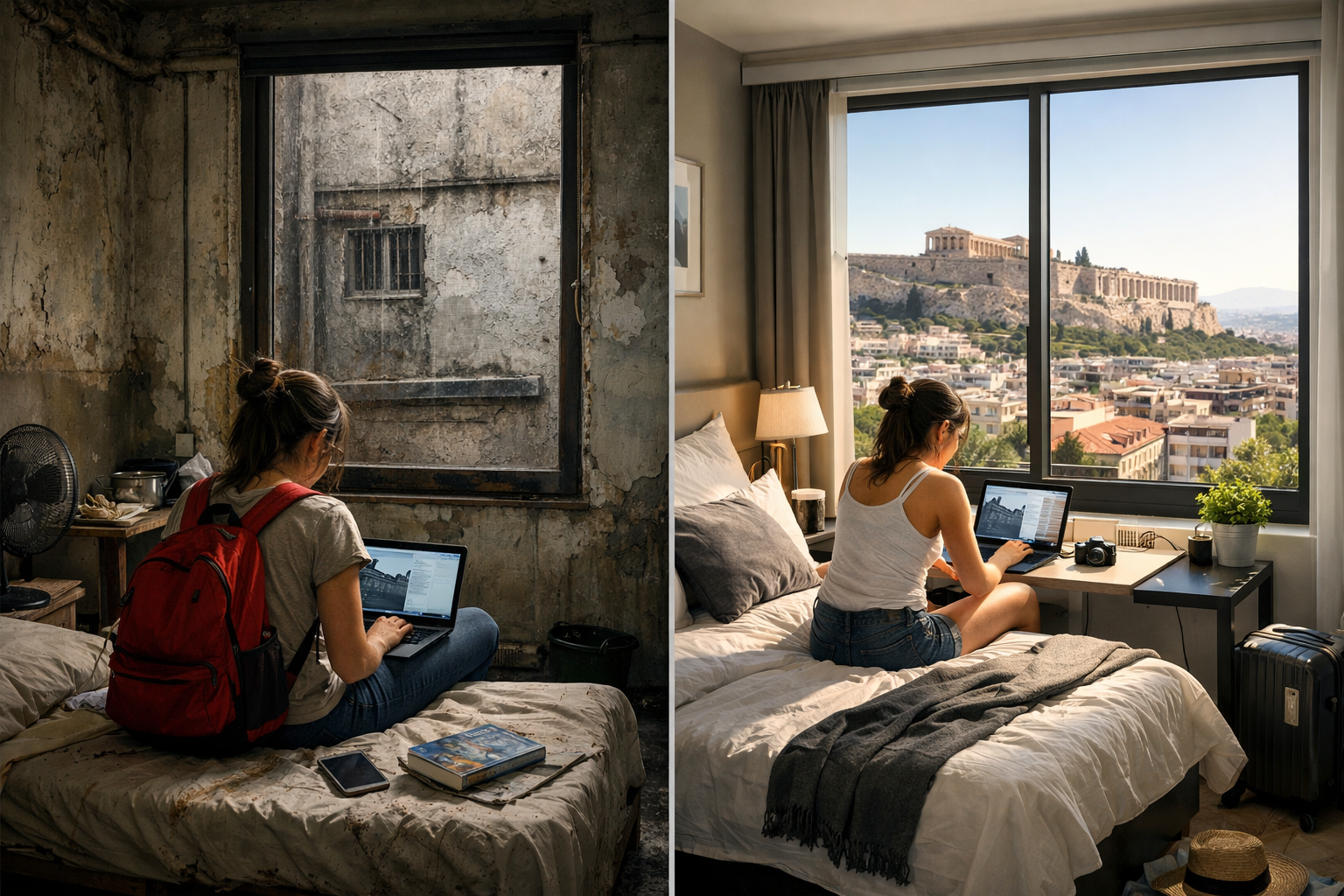
Then you land in Athens and realize you’re paying €520 for a shoebox in a random area with a 45-minute commute and a landlord who suddenly “forgot” about the contract.
That’s the game.
If you’re searching for student housing athens, you’re not really looking for “accommodation.”
You’re trying to avoid getting overcharged, stuck in the wrong neighborhood, or trapped in a deal that looked good only because you didn’t know the city yet.
This guide is for Erasmus students, interns, and young professionals who want the real version of the market in 2026.
No shiny nonsense. No generic “Athens is affordable” fluff.
Just where to look, what to pay, what to avoid, and how to spot the difference between a fair deal and a bad one wearing good lighting.
What student housing in Athens really costs in 2026
Let’s start with the part everyone wants and half the internet gets wrong: price.
In 2026, Athens is still cheaper than Paris, Amsterdam, or Barcelona. But that does not mean it’s cheap if you choose badly.
For students and interns, these are realistic monthly ranges:
Room in shared apartment: €320–€500
Studio apartment: €450–€700
Small one-bedroom: €600–€850
High-demand central areas, renovated units: often €50–€150 above average
If someone tells you every decent room in central Athens costs €250, they’re living in 2019.
If someone tries charging you €650 for a basic room with old furniture and no proper contract, they’re testing whether you’re new.
You are.
But you don’t have to look like it.
Best areas in Athens if you want to save money without hating your commute
The trick is not just finding cheap rent.
The trick is finding an area where the rent, commute, safety, and daily life actually make sense together.
Exarchia: central, student-heavy, still worth it if you choose carefully
Exarchia is one of the first neighborhoods international students hear about.
For good reason.
It’s central, full of students, cafés, bookstores, late-night food, and actual city life.
You can walk to Omonia, Panepistimio, parts of Kolonaki, and some university buildings depending on where you are.
Price range in 2026:
Room in shared flat: €380–€520
Studio: €500–€700
The catch?
Not every street feels the same.
Some parts are lively and convenient.
Some are noisy, rougher around the edges, or poorly maintained.
Great for the right person. Annoying for the wrong one.
If you want the social energy, Exarchia works.
If you think every flat there is automatically a bargain, no.
Pangrati: one of the smartest picks right now
Pangrati has become the “I know Athens a bit” choice.
It’s popular because it actually works: central-ish, walkable, full of cafés, safer-feeling than some other student-heavy zones, and close enough to Syntagma, Evangelismos, and the city center to make life easy.
Price range:
Room in shared flat: €400–€550
Studio: €550–€750
It’s not the cheapest anymore, but it often gives better value than the super-hyped center.
If your internship is near central Athens, Pangrati can save time daily even if the rent is a bit higher.
And commute time matters more than students think when they first search.
Kallithea: practical, connected, better value than people expect
Kallithea is often overlooked by international students who obsess over being “in the center.”
That’s a mistake.
It has better prices than many central districts, solid transport options, and easy access toward the center and the coast.
Depending on where you live, you can use the metro, electric railway, buses, or tram connections nearby.
Travel time to central Athens is often around 15–25 minutes.
Price range:
Room in shared flat: €330–€470
Studio: €450–€650
For interns, young professionals, and students who want a more functional daily setup, Kallithea makes a lot of sense.
Kypseli: big neighborhood, mixed quality, strong value if you know where to look
Kypseli is not one thing.
That’s where people mess up.
Some parts feel vibrant and full of character.
Others feel tired, noisy, or disconnected depending on your exact street and building. But if you know how to choose, Kypseli can offer very solid value.
Price range:
Room in shared flat: €320–€450
Studio: €430–€620
Commute matters here.
Some spots rely more on buses or a longer walk to transport.
So check the exact route to your university or workplace, not just the neighborhood name.
If budget is tight, Kypseli should absolutely be on your list.
Sepolia: affordable, metro-access advantage, less trendy but useful
Sepolia doesn’t make many “best Athens neighborhoods” lists.
Good.
That’s part of why it can still be affordable.
It’s a practical option for students who care more about price and metro access than aesthetics.
With Line 2 nearby, getting toward Omonia, Panepistimio connections, or Syntagma is manageable.
Travel time into more central zones is often around 10–20 minutes by metro, depending on the destination.
Price range:
Room in shared flat: €300–€420
Studio: €400–€580
Not glamorous. Often effective.
Kolonos: another budget-friendly area people skip too fast
Kolonos gets ignored mostly because students don’t know it well.
That’s exactly why it can offer better deals.
You can find lower rents than in the trendier central neighborhoods, and depending on the exact location, you’re still not far from metro access and central Athens.
Price range:
Room in shared flat: €300–€430
Studio: €420–€600
The building matters a lot here.
One apartment can be a bargain.
Another in the same area can feel depressing. Never judge only by district name.
How to choose the right area for your actual life
Students often search like tourists.
That’s expensive.
Don’t pick a neighborhood because it sounds cool on TikTok or because someone said “it’s central.”
Pick it based on your weekly routine.
Where is your university, internship, or office?
Do you need metro access or are buses enough?
Do you want nightlife outside your door or sleep?
Are you okay paying more to walk everywhere?
Would you rather spend €80 less and commute 15 minutes longer?
If you’re still comparing districts, the breakdown in our guide to affordable areas for students in Athens helps you think beyond rent alone.
And if your schedule is packed, it’s worth understanding what a daily commute in Athens really looks like before committing to a “cheap” room that’s cheap for a reason.
The most common ways students overpay
Here’s where people burn money.
1. They panic-book in August or September
The later you search, the worse your options get.
Owners know last-minute international students are stressed.
That’s when average rooms suddenly become “special opportunities” at inflated prices.
Start early.
Compare more than one area. Don’t wait until the market starts smelling your desperation.
2. They pay central premiums for no real benefit
Living five minutes closer to the center can easily cost you €100–€150 more per month.
Sometimes that’s worth it. Often it isn’t.
A room in Kallithea, Sepolia, or Kypseli with a sane commute can beat an overpriced room in a trendier district every single day of the week.
3. They confuse renovated with worth it
Fresh paint and an IKEA lamp do not automatically justify a high rent.
Check what you’re actually paying for:
Real square meters
Transport access
Air conditioning
Washing machine
Functional kitchen
Building condition
Official contract
If the room looks modern but the commute is bad, the street is terrible, and the landlord wants cash only, it’s not “premium.” It’s lipstick on a problem.
4. They ignore extra costs
Always ask what is included.
Utilities, internet, building fees, and heating can shift the real monthly cost fast.
A €380 room can become a €470 room once the hidden stuff appears.
If you want a cleaner checklist, our article on what students should ask before renting in Athens will save you from the usual rookie mistakes.
Scams and traps to avoid in Athens
Some are obvious. Some are not.
No contract = bad idea
If a landlord avoids paperwork, that’s not “casual.” That’s risk.
You want an official contract.
Otherwise you have very little protection if the rent changes, the deposit disappears, or the apartment conditions magically worsen.
Fake photos or old photos
Very common.
Ask for recent photos or video.
Better yet, work with direct providers offering verified rooms instead of some random listing that has been recycled for two years.
Deposit pressure before basic verification
If someone is pushing hard for immediate payment before showing proof, details, contract terms, or proper identification, slow down.
A real rental deal can move fast. A scam always wants you rushed.
Prices that are suspiciously low
A central “fully renovated” studio for €260 is usually one of three things:
Fake
Already gone and used to bait inquiries
A disaster with undisclosed problems
Athens has deals.
It does not have miracles every day.
A smarter way to rent without platform markups
This is where a lot of students lose money for no reason.
Big listing sites and middleman-heavy setups often mean extra fees, weaker verification, or a lot of time wasted chasing half-real offers.
That’s why going direct matters.
RoomsAthens is not a platform.
We directly offer rooms and apartments in Athens, which means no platform fees, verified rooms, and official contracts.
For students arriving from abroad, that removes a lot of the chaos.
Especially when you can’t afford to land in Athens and discover the “great deal” was mostly fiction.
If you’re early in your search, it also helps to check our guide on how to rent a room in Athens before arrival, because timing and process make a bigger difference than most first-time renters expect.
How to get a fair deal in 2026
Here’s the short version.
Start searching early
Compare neighborhoods, not just listings
Calculate total monthly cost, not base rent alone
Prioritize metro access or realistic commute times
Ask for an official contract
Don’t confuse “central” with “better”
Don’t send money because someone sounds urgent
Use direct landlord options when possible
That’s how you stop overpaying.
Not with luck. With better filters.
Final word: the wrong room costs more than rent
Bad housing in Athens doesn’t just cost money.
It costs time, sleep, peace of mind, and usually a piece of your deposit too.
The wrong area drains you with pointless commuting.
The wrong landlord creates stress you absolutely do not need during Erasmus, an internship, or your first months working in the city.
And the wrong “deal” usually stops looking cheap very fast.
If you want a safer, smarter route, explore the available rooms at RoomsAthens and apply early.
You’ll skip platform fees, avoid the sketchy stuff, and rent with verified rooms and official contracts instead of gambling on listings that may not survive first contact with reality.
That’s the move in 2026.